How to Write a CV: Full guide
Check out our 6 golden rules to follow when writing a CV along with a step-by-step guide on how to write your CV in the Netherlands

Welcome to our CV writing guide!
This article provides you with essential tips and best practices to write a winning CV: one that lands you interviews.
While in the first part of this guide, we present 6 golden rules you should follow when writing your CV, the second section provides you with a step-by-step guide to writing your CV, section by section.
After you finish writing or improving your CV, we encourage you to book a free Job Hunt Advice session with us.
Let’s dive in!
6 GOLDEN RULES WHEN WRITING YOUR CV
1. Tailor your CV to each job application
The first golden rule: tailor your CV to each job application! Sending identical CVs to various employers will help you save time yes, but may not have the best success rate. Indeed, even if jobs or companies seem similar, they may require distinct skill sets and professional styles.
Therefore, we recommend you match your CV with the job descriptions you're applying for and customize it for each position. Take time to examine the job advertisement and incorporate your relevant professional experience, academic achievements, and skills.
2. Keep it short and sweet
To maximize your chances of being noticed by recruiters, limit your CV to one page if you have less than five years of experience. It's essential to keep in mind that recruiters spend an average of 7 seconds reviewing a CV. Yup, 7 seconds!
Therefore, be concise and straightforward (especially if you’re applying in the Netherlands!). Only include pertinent skills and accomplishments to make your CV as brief as possible. Additionally, it's best to write your CV in reverse chronological order to showcase your most recent and relevant experiences first.
3. Keep it as simple as possible
As previously explained, recruiters typically spend only a few seconds scanning your CV. Therefore, if you work in a profession that doesn't emphasize creativity, like graphic design, a straightforward and formal-looking CV may be the best choice.
Indeed, using flashy colours, an unorthodox layout or unusual phrasing could backfire and cause your CV to be rejected by the Applicant Tracking System (for those of you who are not familiar with ATS: this is a robot that scans your CV when you apply via online portals).
To make it past this first selection round, our advice is to:
- Stick to a common font (e.g. Calibri) and a regular font size of 11-12 points
- Use keywords from the job description
- Limit yourself to a maximum of two colours in your CV
- Have a clear CV outline: summary, work experience, academic background, skills and languages
Sometimes, the simplest way to attract attention is by keeping things simple.
Then again, find out more about the company you’re applying to, get familiar with their tone, their style and adapt your CV to it. Originality may work in your favour too. It’s about finding the right balance and playing it safe when in doubt!
4. Use bullet points
Bullet points can be incredibly helpful for your CV as they enhance clarity, concision, and ease of scanning by both recruiters and ATS. By using bullet points, you avoid using lengthy paragraphs to describe your employment history and gain valuable space.
For optimal results, aim for 3-4 bullet points depending on your level of experience. To make them more impactful, begin each bullet point with a power verb (e.g.: “Led”, “Optimized”, “Designed”, “Streamlined”, “Completed”). This technique enables you to communicate your skills and accomplishments in a more dynamic and memorable way.
5. Adopt an achievement-oriented writing style
Crafting an effective CV involves more than just outlining previous work experience and education. To stand out, it's crucial to showcase noteworthy accomplishments, projects, and concrete results that you've contributed to.
When detailing your relevant work experience, be sure to provide concrete examples, such as numbers, client names, and project outcomes. These details provide context for your achievements and demonstrate your ability to make a tangible impact in your previous roles.
6. Avoid typos and grammatical errors
However beautifully crafted and content-rich your CV is, spelling or grammatical errors will impact your credibility.
It is therefore essential to ensure your CV is free of these. We highly recommend using spellcheck tools such as Grammarly, especially if you are not a native Dutch or English speaker. By using Grammarly, you can focus on the content of your CV without worrying about spelling mistakes.
HOW TO WRITE A CV STEP-BY-STEP
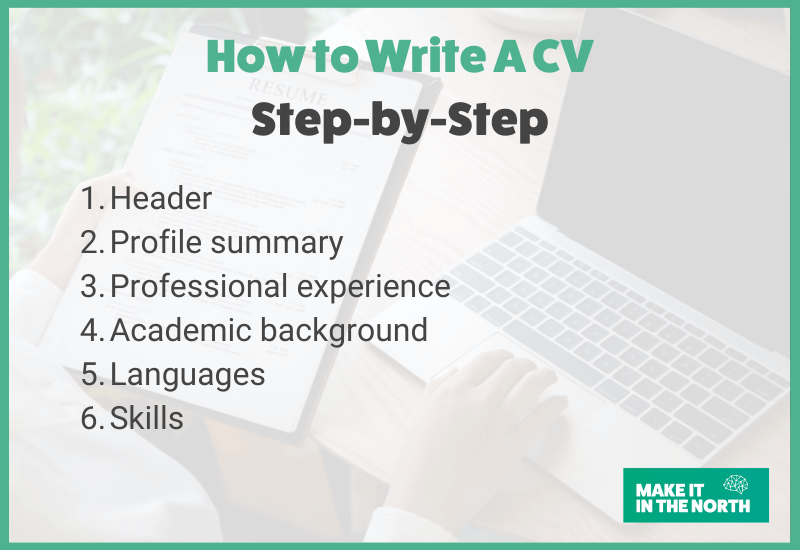
Welcome to the second part of this guide! Keep the above tips in mind and get to typing! Below, we describe how you should write each CV section, from top to bottom.
1. Header
Your CV header is the first (and easiest) CV section to write. This is where you should include information such as:
- First name and last name
- Job title: tailor this to the job you are applying for, e.g. “Communication Specialist”
- Contact details: a professional email address, LinkedIn profile link, and phone number (include the country code at all times!)
- Location: your full address is not necessary, just stick to city and country (e.g.: Groningen, Netherlands)
- Photograph: including a picture on your CV is common in the Netherlands, as long as you keep it professional!
2. Profile summary
Even though presented right below your header, we recommend you write your profile summary last. This section summarizes your expertise, professional experience/academic background and skills in 2 to 3 impactful sentences.
Writing it after having completed your professional experience/academic background and skills sections will make your life easier as you’ll essentially be summarising what’s on your CV.
In a nutshell, it should contain your:
- Current job title/expertise or academic level
- Level of experience (in years)
- Key achievements
- Key relevant skills (2 to 3 skills)
- How you can contribute to the company/department/team objectives
Make sure you put a lot of effort into this section: this may be the first paragraph the recruiters will read, let’s keep them captivated!
3. Professional experience
The first important rule about this section: it should be tailored to the job description. This means you should only include professional experience that is relevant to the position you are applying for.
For instance, if you are applying for a marketing position, including your dog-walking experience in your CV is unlikely to be of help.
As mentioned at the beginning of this guide, we strongly recommend you use bullet points when presenting your professional experience. Start each bullet point with a power verb in the past tense.
Here is what you should include for each experience:
- Company name
- Job title
- 3-4 bullet points highlighting your achievements
- Dates during which you held the position
4. Academic background
The same principle applies to your academic background. It's important to only include relevant information, along with concrete examples and achievements.
If you have limited work experience, consider including notable achievements from your academic background, such as theses or group projects, and align them with the job description. These projects may have helped you develop transferable skills that could be beneficial for the role you're applying for.
Alternatively, if you have substantial work experience, you can just stick to listing your school or university name, program name, and dates of attendance.
To summarize, be sure to include the following in your academic background:
- Dates
- School or university name
- Program name
- Achievements
5. Languages
Whether you speak 1 or 5 languages, we recommend you always include a language section in your CV.
In the Netherlands, fluent English and/or Dutch is the minimum requirement. If you’re an English speaker learning Dutch, make sure to include that too. You want to show that you’re proactively trying to adapt and willing to learn the language of your host country!
When presenting your languages, it's important to state both your level of proficiency in words and an internationally-recognized language score or certificate.
Here's an example of how you can present your language skills in your CV:
- English: Native
- German: Conversational (B2)
- Dutch: Basic (currently enrolled in an A2-level course)
Be sure to include both your level of proficiency and the associated language score, as the former may seem abstract and the latter may not be known by employers.
6. Skills
Finally, we highly recommend you include a skills section in your CV. Try to find a balance between the hard and soft skills the employer is seeking. The best way to include relevant skills in your CV is to highlight those that the employer included in the job description and incorporate them into your CV. Of course, make sure you actually possess the skills!
In sum, here is how you can incorporate skills into your CV:
- Creating a dedicated skills section
- Incorporating them into your career or work experience accomplishments
Summary
We hope this practical guide helps you write or improve your CV, one that lands interviews.
In a nutshell, keep in mind that a winning CV should be tailored to the job advert, highlight your achievements, include relevant skills, be well-structured and eye-catching, and be compatible with Applicant Tracking Systems (ATS).
Writing a solid CV takes time and effort, granted. But you’ll soon see that it’s worth it: that time and effort will make you stand out from other candidates!
Done writing slash improving your CV? Book a free Job Hunt Advice session to find out what the next steps are in your career path, and check out these other career services you can use. And don't forget to create your Jobseeker Dashboard account, to track your progress and save international-friendly jobs!